

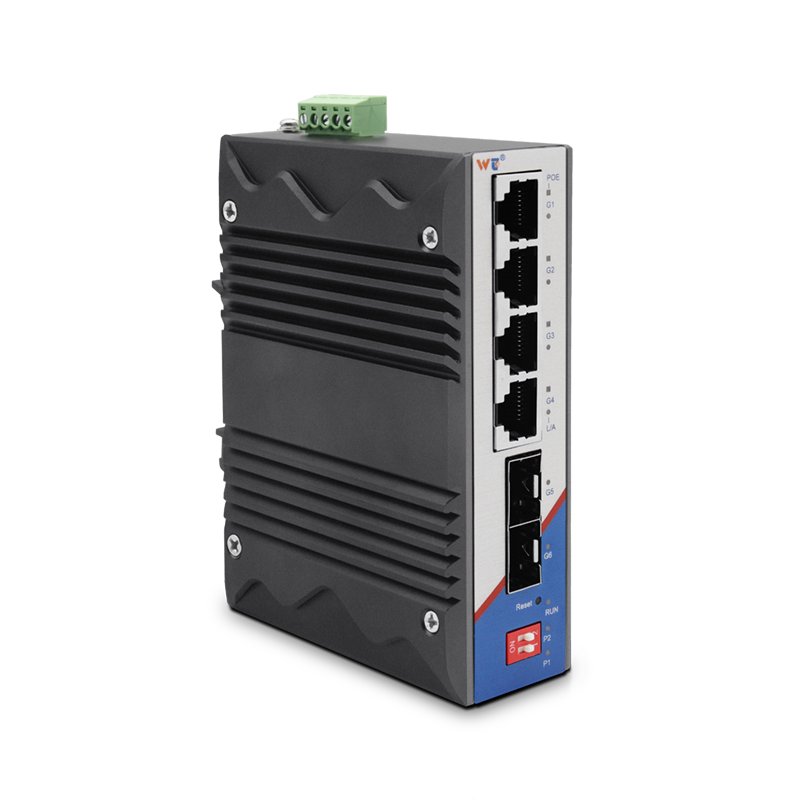
Deploying communication networks outside climate-controlled facilities introduces severe environmental hazards that quickly degrade standard commercial hardware. Installing a rugged ethernet switch in utility cabinets, transit lines, or power sub-stations maintains steady data connectivity despite extreme ambient temperatures, continuous mechanical vibration, and severe electromagnetic interference. Physical hardening enables critical network nodes to process high-throughput data traffic without suffering thermal shutdowns or frame corruption.
Unconditioned field environments subject network electronics to harsh operational variables including dust ingress, moisture, and unregulated voltage spikes. Standard commercial switches housed in plastic enclosures rely on internal cooling fans that pull airborne contaminants directly onto sensitive circuit boards. Replacing vulnerable commercial hardware with industrial-grade switching components stabilizes data communication channels across remote municipal and industrial infrastructure.
Thermal Management Mechanisms and Fanless Architecture
Operating reliably across wide temperature swings requires innovative thermal engineering within switching hardware. Standard office switches function within narrow thermal windows, whereas industrial variants operate across extended ranges spanning minus forty to seventy-five degrees Celsius. Passive fanless designs utilize heavy-duty metallic enclosures as integrated heat sinks, pulling internal heat away from processing chips without introducing mechanical fan components that risk mechanical failure.
Eliminating mechanical cooling fans drastically increases Mean Time Between Failures for field-deployed hardware. Open fan vents expose internal electronics to humidity and corrosive airborne particles, whereas sealed IP40-rated metal housings shield sensitive printed circuit boards. Superior heat dissipation combined with solid-state components protects switching electronics against thermal runaway during extreme heat conditions.
Electromagnetic Shielding and Power Surge Protection
Electrical substations, heavy manufacturing facilities, and railway signaling networks generate powerful electromagnetic fields that interfere with unshielded electronics. Hardened switches feature high-level Electromagnetic Compatibility shielding to block inductive noise from large electric motors, transformers, and high-voltage power lines. Robust circuit designs preserve signal integrity, preventing frame dropouts and packet errors across critical control links.
Power infrastructure in field deployments remains susceptible to sudden line surges, lightning strikes, and electrostatic discharges. Industrial switches incorporate redundant dual DC power inputs alongside high-capacity surge protection components. Redundant power terminals allow dual power supplies to maintain continuous system operation if one power feed fails or experiences an electrical fault.
Physical Form Factors and Mechanical Stress Resistance
Vibration and mechanical shock represent continuous risks along transportation corridors and industrial processing lines. Standard desktop or rackmount chassis can suffer loose cable fittings and cracked solder joints under constant mechanical stress. Utilizing DIN-rail mounting mechanisms allows switches to snap securely onto standard industrial rails inside compact control cabinets, absorbing operational shocks without disconnecting.
Heavy aluminum or steel alloy enclosures provide structural rigidity, shielding internal components against mechanical impacts and physical stress. Sealed connector ports prevent cable loosening caused by high-vibration environments such as railway cars and heavy machinery bays. Choosing shock-resistant physical architectures prevents physical disconnection and maintains stable physical-layer links in demanding settings.
Redundant Topology Protocols and Fast Network Recovery
Mission-critical networks cannot tolerate extended service outages caused by physical cable damage or hardware port failure. Industrial switches implement specialized ring redundancy protocols like Ethernet Ring Protection Switching to re-route network traffic in under twenty milliseconds following a link break. Rapid recovery prevents automated production lines or traffic management systems from entering fault states due to brief communication delays.
Combining ring protection protocols with Quality of Service traffic management verifies that priority operational data reaches target destinations without delay. Video surveillance streams, SCADA control signals, and voice traffic receive higher queue priority over standard data transfers. Managed traffic control maintains predictable performance across heavily loaded industrial communication rings.
International Certification Standards and Quality Benchmarks
Verifying hardware suitability for mission-critical deployments requires compliance with rigorous international safety and environmental certifications. Standard certifications such as CE, UL, and RoHS verify that electrical hardware meets stringent safety guidelines, flame resistance, and hazardous material limits. Certified hardware gives system integrators confidence that installed equipment aligns with regional electrical codes and safety mandates.
Specific industry applications require compliance with specialized standards, such as EN 50121-4 for railway signaling or IEC 61850-3 for electric power substations. Substation environments subject electronics to extreme electrostatic discharges and power surges, demanding tested isolation barriers inside network equipment. Selecting hardware built to verified compliance standards reduces operational risk and deployment delays.
Practical Applications across Smart Cities and Utility Grids
Modern smart city infrastructure relies on hardened switching hardware to aggregate data from distributed municipal field devices. Intelligent transportation systems utilize outdoor rugged ethernet switch models to connect traffic sensors, electronic messaging signs, and high-definition IP cameras to central monitoring networks. Secure physical housings combined with Power over Ethernet capabilities allow single switches to power edge devices while backhauling critical data over fiber networks.
Power utility companies deploy industrial Ethernet switch hardware inside automated distribution substations to monitor circuit breakers and power transformers. Hardware deployed by WINTOP supports diverse deployment needs through versatile Layer 2 managed switch configurations, unmanaged models, and smart dial switch options. Combining flexible port density with hardened physical construction supports scalable network development across enterprise and utility infrastructure.
Hardware Selection Guidelines for Industrial Networks
Building a dependable outdoor network architecture involves evaluating total port density, bandwidth demands, power requirements, and mounting boundaries. System designers assess whether unmanaged switches suit straightforward edge connections or if managed switches are needed to support VLAN segmentation and remote telemetry monitoring. Evaluating field device power draw confirms whether standard PoE or high-power PoE++ interfaces are necessary.
Evaluating manufacturer engineering capabilities and product customization services supports successful long-term system integration. Sourcing switches backed by international certifications helps lower lifecycle maintenance costs and supports long-term network expansion goals. Reliable options like WINTOP industrial Ethernet switch products provide durable connectivity solutions for complex municipal and industrial projects.
Conclusion
Understanding environmental hazards, thermal management designs, physical hardening standards, and redundancy protocols enables engineers to select appropriate switching hardware for harsh environments. Deploying robust physical-layer equipment protects communication lines, maintains operational uptime, and lowers total cost of ownership across outdoor and industrial deployments.
Shenzhen Wintop Optical Technology Co., Ltd. brings 21 years of specialized expertise as a national high-tech enterprise focused on optical communication and network hardware development. With over 60 core technical patents and international certifications including CE, UL, and RoHS, WINTOP manufactures industrial Ethernet switches, PoE hardware, and custom OEM networking equipment for partners in 40 countries. Contact technical representatives today to explore customized networking hardware options designed for mission-critical deployments.
