

Power semiconductor performance depends on more than the switching device itself. Gate-drive circuits, protection functions, electrical interfaces, and system validation all influence how reliably a power converter operates. For manufacturers developing inverters, motor drives, and energy storage equipment, cooperation between gate-driver suppliers and power module manufacturers is therefore an important part of product engineering. Firstack participates in this ecosystem with gate-driver cores and power electronics testing solutions designed for demanding applications.
Why Gate Drivers Matter to Power Module Manufacturers
IGBT modules switch high currents and voltages in power conversion systems. However, their switching behavior depends partly on how gate signals are generated and controlled. An IGBT gate driver must deliver suitable gate voltage and current while maintaining electrical isolation and responding appropriately to abnormal operating conditions.
For a power module manufacturer, driver compatibility affects more than basic switching functionality. Gate resistance, switching speed, parasitic inductance, and protection thresholds influence switching losses, electromagnetic interference, and device stress. A suitable IGBT gate driver must therefore be evaluated against the module’s electrical characteristics and the converter’s operating requirements.
Close technical cooperation can reduce integration difficulties. Module manufacturers understand the device’s limits and recommended operating conditions, while driver suppliers contribute expertise in signal isolation, gate control, and fault management. Sharing interface specifications and test results helps engineering teams identify incompatibilities earlier in development.
Firstack 2FHC0435: A Compact Gate Driver Core for 1700V IGBT Modules
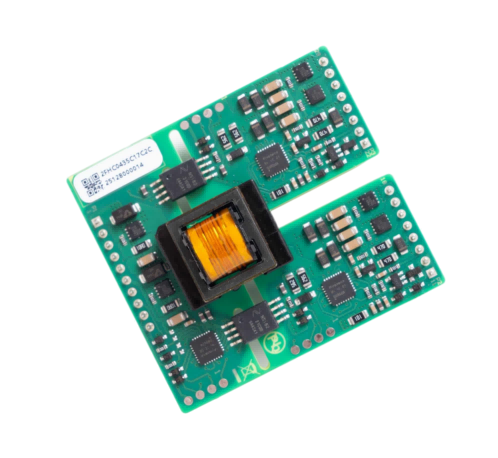
The Firstack 2FHC0435 illustrates how an integrated driver core can support this collaboration. Based on Firstack’s digital ASIC technology, the dual-channel design supports 1700V IGBT modules, including modules rated up to 1800A under the stated product specifications. Its compact architecture can help equipment developers integrate gate-drive functionality without designing every driver circuit from the beginning.
Key specifications include 4W output power per channel at an ambient temperature of up to 85°C, a peak gate current of 35A, and an operating ambient temperature range of -40°C to 85°C. This product features dual channels and electrical interfaces, supports multi-level topologies, and is currently available in configurations for direct drive (Direct) and half-bridge applications.
The specified on-state gate voltage can reach 15.5V, while the product’s electrical characteristics list a nominal turn-on voltage of 15V. Engineers should consult the applicable datasheet when establishing operating conditions and checking compatibility with a particular module.
For manufacturers integrating high-power switching devices, these characteristics provide a starting point for evaluating driver suitability. Actual performance still depends on the selected module, circuit layout, switching frequency, cooling arrangements, and application conditions.
Protection Functions and System-Level Reliability
Protection is a shared concern for driver suppliers and module manufacturers. Excessive current, short circuits, or unstable supply voltages can threaten semiconductor devices if faults are not detected and managed appropriately. Protection design must account for both detection speed and the consequences of switching the device off.
The 2FHC0435 includes power-supply monitoring, undervoltage lockout (UVLO), collector-emitter voltage monitoring, and short-circuit protection with soft shutdown. Active clamping is also listed among its supported features. These functions help address abnormal operating conditions, although their effectiveness depends on correct circuit implementation and application-specific configuration.
Intelligent fault management can also help distinguish fault conditions, supporting more useful diagnostic feedback during system operation. Engineers should verify protection thresholds, response behavior, and shutdown procedures through appropriate testing rather than assuming that a driver’s built-in functions eliminate every system risk.
The product’s stated safety segregation standard is EN50178, with Level-2 protection. Design teams must still assess the complete equipment’s insulation coordination and applicable safety requirements. Component-level compliance alone does not establish compliance for an entire converter.
Validation Across the Supply Chain
Effective collaboration extends from initial design through qualification and manufacturing. Device-level checks establish electrical behavior, board-level testing verifies driver integration, and module-level evaluation examines switching waveforms and protection responses. System-level testing then assesses interactions under representative loads and operating conditions.
A power module manufacturer can use this process to confirm that a selected driver operates as intended with its devices. Testing should consider switching losses, voltage overshoot, thermal behavior, electromagnetic compatibility, and fault response. These checks become especially important when modules are integrated into new converter topologies or operating environments.
Firstack specializes in the research, development, and sales of power semiconductor drivers, power stacks, and testing equipment. Its full-chain validation approach covers device, board, module, and system levels, helping engineering teams assess performance and reliability while reducing development time. Digital supply chain management and automated production further support traceability, process visibility, and delivery coordination.
For original equipment manufacturers and system integrators, these capabilities can help connect component selection with qualification and production planning. Clear technical documentation, repeatable test procedures, and consistent communication between suppliers remain essential to successful integration.
Building Stronger Partnerships in Power Electronics
Reliable power conversion requires coordinated engineering across semiconductor devices, gate-drive electronics, protection circuits, and system testing. A capable IGBT gate driver must match the module’s electrical requirements while supporting safe switching and effective fault handling.
The Firstack 2FHC0435 offers dual-channel driving, 4W output power per channel at 85°C ambient temperature, 35A peak gate current, and multiple protection functions for compatible 1700V IGBT applications. By combining suitable component selection with structured validation, manufacturers can reduce integration risks and build more dependable power conversion equipment. Strong collaboration between driver suppliers and power module manufacturers helps turn individual component capabilities into reliable system performance.
