

Outdoor job sites don’t offer much mercy to electronic equipment. Rain, dust, temperature swings, and long open distances between operator and machine all put pressure on a handheld transmitter that indoor equipment never has to face. Choosing the right unit for outdoor crane, hoist, or lifting operations means weighing several practical factors at once — durability, range, battery life, and control complexity — rather than picking based on button count alone.
Durability Standards for Outdoor Exposure
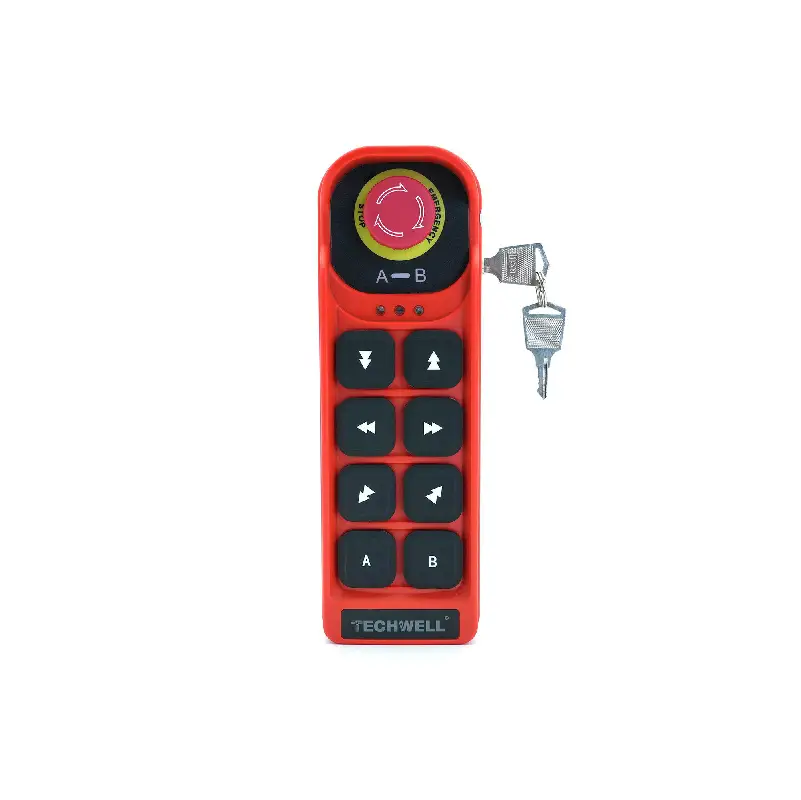
The first question for any outdoor handheld control is whether it can actually survive the environment. Ingress protection ratings offer a concrete way to compare this, since they describe resistance to both dust and water rather than relying on general claims of ruggedness. Techwell’s BES08 transmitter, for example, carries an IP66 protection rating and uses an engineering-plastic enclosure designed for industrial use. That level of protection matters on construction sites, where equipment is regularly exposed to rain, mud, and airborne debris throughout a working shift.
Temperature range is the other half of the durability picture. A handheld unit that performs well in a controlled facility can behave unpredictably once it’s exposed to a cold morning start or a hot midday sun. According to Techwell Remote Control‘s published specifications, the BES08 operates across a -25°C to 70°C range, with humidity tolerance up to 97% RH in non-condensing conditions. Together, these figures give buyers something measurable to check against their own site conditions, rather than trusting general durability language.
Balancing Compact Size with Ergonomic Handling
Outdoor operators often carry a transmitter for an entire shift, sometimes while climbing, walking long distances, or operating with one hand. Size and weight become practical concerns, not just design details. The BES08 measures 190 × 63 × 45 mm and weighs 0.2 kg excluding batteries, giving the unit a compact and lightweight form factor. A compact housing also tends to be easier to clip to a belt or store safely when not actively in use, which matters on sites where a dropped or misplaced transmitter can interrupt work.
Signal Range for Open Outdoor Sites
Indoor facilities are relatively contained, but outdoor sites — particularly large construction yards, mining pits, or port terminals — often require an operator to move well away from the machine for a clear line of sight. Wireless range is an important consideration for outdoor applications, but the specified distance should be understood in the context of its testing conditions. Techwell specifies a wireless range of ≥150 meters for the BES08 under open-area conditions without interference.
In actual job sites, the effective operating distance may vary due to obstacles such as buildings, metal structures, heavy machinery, and other sources of radio interference. When selecting a remote control for outdoor work, buyers should also consider its resistance to harsh weather, signal stability in changing site conditions, grip comfort, ease of operation, and standby performance. These factors all influence whether the transmitter is suitable for extended outdoor use, particularly when operators need to maintain control over equipment throughout a working shift.
Power Source and Battery Life Considerations
An outdoor handheld control that requires frequent battery changes can create unnecessary downtime, particularly at remote sites where charging facilities may not be readily available. The BES08 uses two standard AA dry cell batteries, which are widely available and can be replaced without relying on a proprietary battery pack or dedicated charging equipment. This offers practical convenience for outdoor crews who need to keep replacement batteries accessible during extended shifts or work in locations with limited supply access.
Matching Control Complexity to the Task
Not every outdoor task requires an advanced transmitter with joysticks, displays, or programmable functions. Many crane and hoist operations are straightforward — raise, lower, extend, retract — and a simpler control scheme can actually reduce the chance of operator error. The BES08 is built around 8 self-resetting pushbuttons, positioning it for facilities that need dependable, no-frills wireless control rather than added complexity. BES08 handheldtransmitter built this way tend to suit repetitive lifting tasks where speed and simplicity matter more than programmable flexibility.
Where This Fits Into a Broader Product Range
Outdoor equipment needs vary by application, and a single handheld model won’t fit every job site equally well. Techwell positions the BES08 within its Bull E button-transmitter lineup, alongside other series aimed at different button counts and control layouts. For operations requiring simultaneous, proportional control of multiple axes rather than discrete button presses, the company’s joystick-based transmitters are typically a better match. Reviewing a site’s actual motion requirements — how many functions need control, and whether movement needs to be graduated or simply on/off — is a more reliable way to select equipment than defaulting to the most fully featured option available.
Conclusion
Selecting a handheld control for outdoor equipment operation comes down to matching hardware specifications to real site conditions: ingress protection and temperature range for environmental exposure, size and weight for extended one-handed use, wireless range for the site’s physical layout, and battery type for field practicality. Techwell illustrates this approach with models like the BES08, which pairs IP66 ingress protection and a -25°C to 70°C operating range with a compact housing and AA battery power — a combination aimed at facilities that need straightforward, reliable industrial wireless controls for daily outdoor crane and hoist work rather than a unit built for tasks it will rarely perform.
