

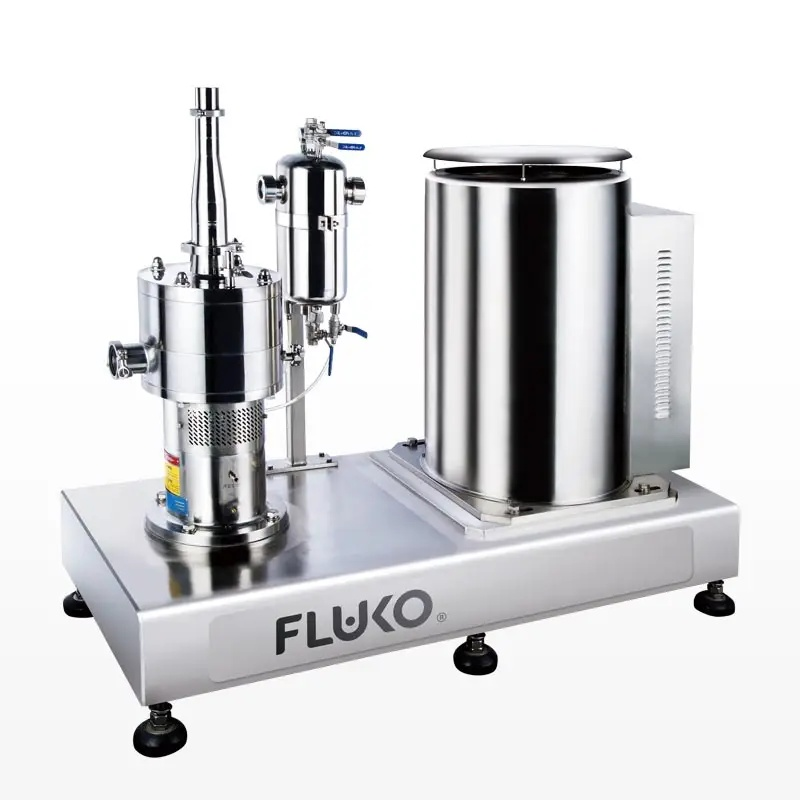
A process can meet its flow target and still deliver an unacceptable emulsion or particle distribution. A narrower particle distribution, a more uniform emulsion, or a repeatable texture places different demands on the working chamber and material path. Process stability and scale-up expectations belong in the comparison as well.
Engineers reviewing an inline high shear mixer should define the measurable product outcome before interpreting speed, power, and capacity. The same rule applies to an inline homogenizer mixer: specifications become useful only after they are connected to the material, treatment intensity, and production rate expected from the line.
Define the Homogenization Result Before Reading the Data
Droplet size, particle distribution, texture, or another agreed result supplies the acceptance threshold. The engineering brief should state the starting condition, required final condition, allowable variation, temperature limits, and whether the result must be achieved in one pass or through recirculation.
A published flow value for an inline high shear mixer cannot answer those questions on its own. The selected inline homogenizer mixer must deliver the required material change at the planned throughput rather than merely move liquid through a chamber.
Without a testable target, two specification sheets may appear comparable even though they describe very different process duties. Measurement methods belong beside the target because different sampling points or test procedures can produce values that are not directly comparable.
The brief should identify where samples are taken, how soon they are measured, and what statistical range is acceptable. Those details turn a general request for uniformity into an acceptance condition that can guide both equipment review and later process validation.
Compare Sanitary Design and Production Line Integration
Process suitability includes cleaning and installation conditions as well as homogenization performance. A sanitary default design and compliance with CIP/SIP cleanliness standards are listed for FLUKO’s compact, stable FDC series, which also uses different shearing configurations. Single-stage and three-stage versions are available.
Those features give an engineer specific fields to place beside the working data for an inline high shear mixer. Space, line connections, cleaning procedures, and access for service also affect whether an inline homogenizer mixer can be incorporated without creating new production constraints. FLUKO states that these machines are designed for quick production-line integration and upgrades.
Translate Chamber Design into Material Treatment
The working chamber controls how the stream encounters the shearing elements. Single-stage equipment provides one principal treatment zone, while a multi-stage design exposes the material to a sequence of zones inside the unit. Geometry, chamber arrangement, and the route from inlet to outlet influence how consistently the stream receives treatment.
An inline high shear mixer should therefore be compared by configuration as well as by motor rating. An inline homogenizer mixer with additional stages is not automatically preferable; the useful question is whether its chamber design produces the required effect without unnecessary processing or an unsuitable flow restriction.
Residence conditions also depend on the surrounding system. Pipe routing, recirculation volume, feed stability, and the number of passes can change how often portions of the product encounter the working region. Engineers should separate effects created inside the chamber from effects created by the line so that a performance gap is not assigned to the wrong component.
Relate Linear Velocity Speed and Power to One Another
Mechanical figures describe different parts of the operating system and should not be ranked separately. Rotational speed identifies how quickly the rotor turns, power indicates drive capacity, and linear velocity describes motion at the working region under the stated design.
For the FDHS series, FLUKO lists a maximum linear velocity of 40 m/s, vertical material intake and discharge, and single- or multi-stage working chambers within an ultra-high-speed design. Engineers assessing an inline high shear mixer still need the actual duty behind those values. The FLUKO inline homogenizer mixer range also includes low-noise operation and no-dead-angle shearing in the FDHS design.
Keep Flow Capacity Tied to Model and Reference Medium
Capacity data gains meaning from the model, test basis, and required product result. In the FDHS range, FLUKO lists the FDHS2/60 at 5.5 kW, 6,000 rpm, and 0.7 m³/h maximum water flow, while the FDHS3/200 is rated at 45 kW, 3,000 rpm, and 10 m³/h.
The larger inline high shear mixer has more power and flow but a lower rotational speed, showing why rpm alone cannot establish scale. Water-flow values for an inline homogenizer mixer should remain labeled as reference data, since the intended formulation may behave differently and may require another operating point.
Convert the Comparison into a Validation Plan
Validation begins with a representative formulation and a defined result, then records the chamber, operating, flow, sanitary, and integration conditions used to reach it. Any missing field should become a supplier question or test item.
A candidate inline high shear mixer merits further evaluation only after its operating window is connected to the real formulation. For an inline homogenizer mixer, measured product quality at the required production rate gives those specifications their engineering value.
