

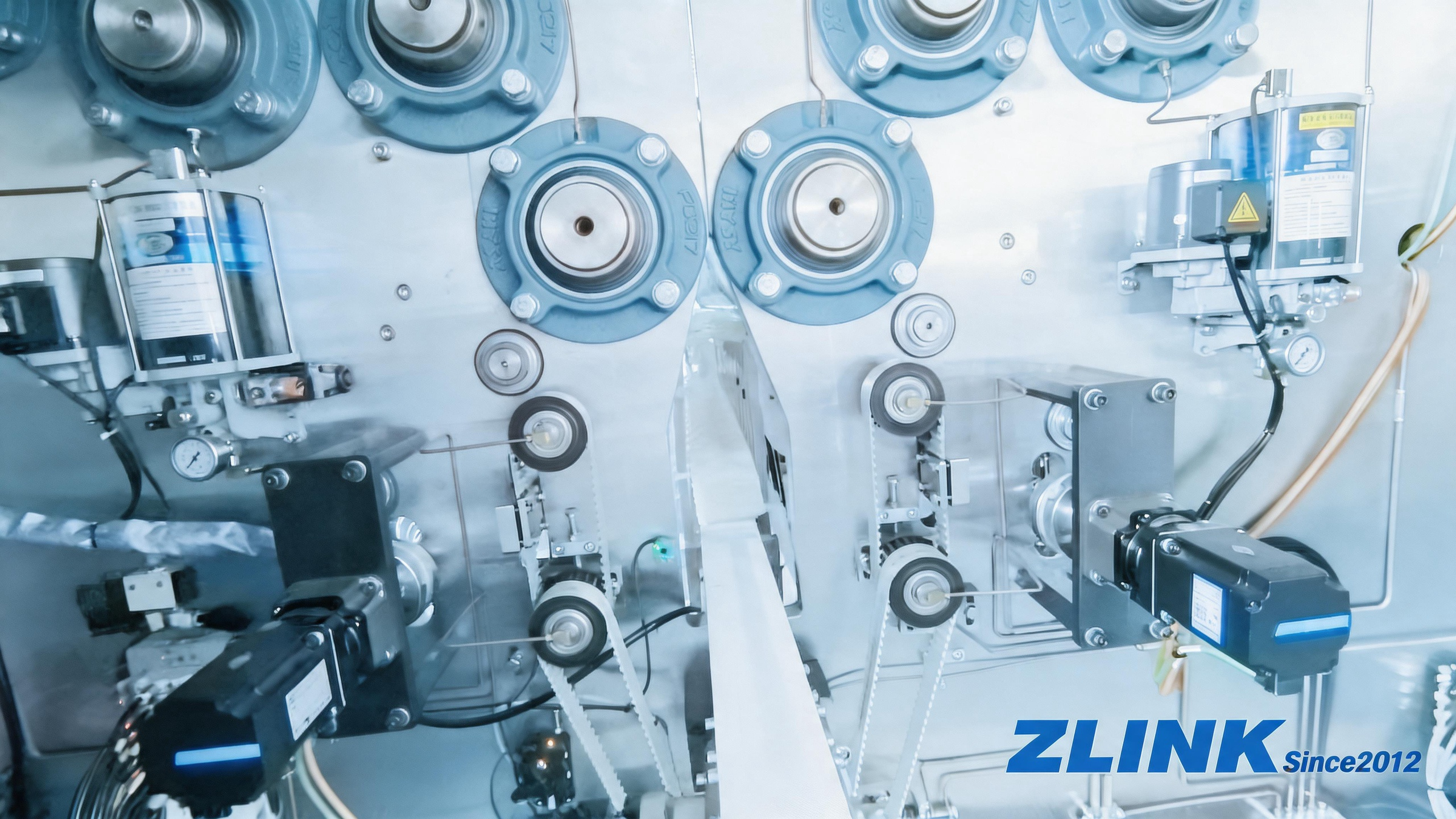
Modern high capacity converting facilities manufacturing pop-up style wet wipes rely on continuous mechanical interfolding systems to ensure smooth sheet extraction for end consumers. Converting plant directors and equipment engineers evaluating machinery options prioritize web tension stability, interfolding accuracy, and liquid saturation uniformity to maintain consistent production throughput. Establishing a continuous manufacturing sequence from raw nonwoven unwinding to primary flow packaging minimizes manual handling while protecting substrate hygiene across extended operating shifts. As a recognized wet wipes equipment provider, ZLINK configures specialized converting lines engineered to support precise interfolding requirements across demanding industrial operating environments.
Automated Nonwoven Web Feeding and Continuous Tension Control
The manufacturing sequence on a specialized pop up wet wipe making machine begins at the nonwoven unwinding assembly, where jumbo substrate rolls are mounted onto dynamic dual axis shafts. Electronic web guiders monitor material movement continuously, correcting lateral displacement before nonwoven sheets enter the slitting assembly.
For pop-up line feeding, teams may review roll width, core size, splice method, and web guide access. ZLINK WT-MD200 configurations can be discussed with tension control and splicing options matched to the substrate. Checking these details can help support stable unwinding as nonwoven lots and product formats change.
Tension sensor rollers maintain uniform web pull, preventing fabric stretching or longitudinal sagging as raw nonwoven sheets travel toward continuous slitting knives. Splicing units perform automated roll transitions during continuous runs, enabling production bays to sustain target velocities without manual machine shutdowns.
Synchronized Horizontal Folding and Continuous Interfolding Mechanisms
After raw nonwoven rolls pass through precision slitting assemblies, separated substrate ribbons move directly into dedicated horizontal folding channels. Driven traction rollers guide individual lanes through specialized forming plates designed to form overlapping Z fold or continuous interfold panel configurations.
Interfolding reviews may consider fold pattern, overlap width, lane count, and stack height. ZLINK WT-MD200 wet wipes making machine configurations can be planned around defined sheet dimensions with forming plates and traction rollers. Reviewing fold samples and maintenance reach together can help support clean panel separation during routine production.
Precise mechanical alignment prevents edge distortion or transverse fiber tearing along nonwoven borders, maintaining uniform sheet dimensions across all processing lanes. Operating a high performance WT-MD200 wet wipes making machine allows factory managers to maintain clean panel interfolding across high volume manufacturing runs reliably.
Precision Lotion Injection and Closed Loop Wetting Assemblies
Delivering precise lotion ratios across folded substrate stacks requires closed loop liquid metering systems and sanitary stainless steel distribution pipework. Multi point spray bars apply lotion formulations evenly onto nonwoven web layers prior to cross cutting, promoting thorough liquid distribution without dry zones. Electronic flow meters track solution consumption continuously, automatically adjusting lotion dosing rates to dynamic line speed variations during startup and deceleration cycles. Sanitary tri clamp fittings and low point drain valves facilitate routine cleaning and pasteurization procedures, assisting converting plants in satisfying international hygiene compliance standards.
Rotary Cross Cutting and High Speed Stacking Operations
Once nonwoven ribbons complete liquid impregnation, synchronized rotary cutter shafts execute clean crosscuts across every active lane simultaneously. Precision engineered cutting blades maintain tight tolerances to prevent edge fraying or incomplete material separation during continuous high speed operation. Cut substrate sheets advance onto dynamic conveyor belts equipped with optical tracking sensors, organizing individual wipes into structured pop-up stacks systematically. Servo driven counting mechanisms transfer stacked wipes into wrapping transport lanes smoothly, ensuring consistent stack spacing as products move toward flow packaging modules.
Primary Flow Wrapping Integration and Sealed Pack Discharging
Organized wipe stacks enter primary packaging machinery where protective barrier films envelop product units in a continuous motion. Multi axis servo controllers synchronize film unwinding, hole punching, and longitudinal thermal sealing to construct air tight packaging enclosures.
Flow wrapping reviews may include film type, pack dimension, punch position, and sealing jaw access. ZLINK packaging modules can be coordinated with servo film feed and sealing controls for defined materials. Checking film samples and line speed changes together can help reduce mismatch between stack arrival and wrapper indexing.
Dynamic sealing jaws adjust contact pressure and sealing temperature based on real time processing speeds, preventing thermal film damage during temporary machine deceleration. Deploying versatile ZLINK wet wipes machinery enables manufacturing plants to connect primary converting units with downstream packaging modules seamlessly, establishing automated continuous workflow across shift cycles.
Digital Line Integration and Comprehensive Quality Assurance
Centralized programmable logic controllers process telemetry data across every converting stage, displaying operational speeds, heating zone temperatures, and solution dosing rates on interactive user screens. Preset product recipes allow rapid parameter adjustments during batch transitions, reducing mechanical downtime between different wipe counts and fabric specifications. Inline vision inspection nodes monitor seal integrity, package dimensions, and optical mark positioning, immediately triggering pneumatic pushers to divert non conforming units. Plant supervisors utilizing centralized digital dashboards optimize overall equipment effectiveness while maintaining repeatable product quality across continuous manufacturing runs.
