

Choosing between a gasoline and diesel generator is not simply a matter of selecting the more powerful engine. For contractors, equipment buyers, facility operators, and other professional users, the better option depends on operating conditions, required output, portability, fuel preferences, and expected workload. Comparing these factors helps purchasing teams assess power equipment manufacturers more objectively and select a generator that fits the application rather than relying on fuel type alone.
Gasoline vs. Diesel: Start With the Application
Gasoline generators are often attractive when portability, flexible use, and moderate power requirements are priorities. They can be suitable for residential backup, outdoor activities, construction work, and temporary power needs where equipment may be transported between locations.
Diesel generators, by comparison, are commonly considered when higher output and demanding operating requirements are involved. The choice should therefore begin with the expected load and duty cycle. A generator intended for occasional backup use may have different requirements from one supporting equipment on a busy construction site for extended periods.
When a Gasoline Generator Makes Sense
For buyers seeking a relatively flexible portable solution in an area where gasoline price is much cheaper, a gasoline generator can provide a practical balance between power and mobility. The raw material cost structure of open-frame gasoline generating sets confers a distinct price advantage over equivalent-power diesel units, making the former more affordable in initial procurement.
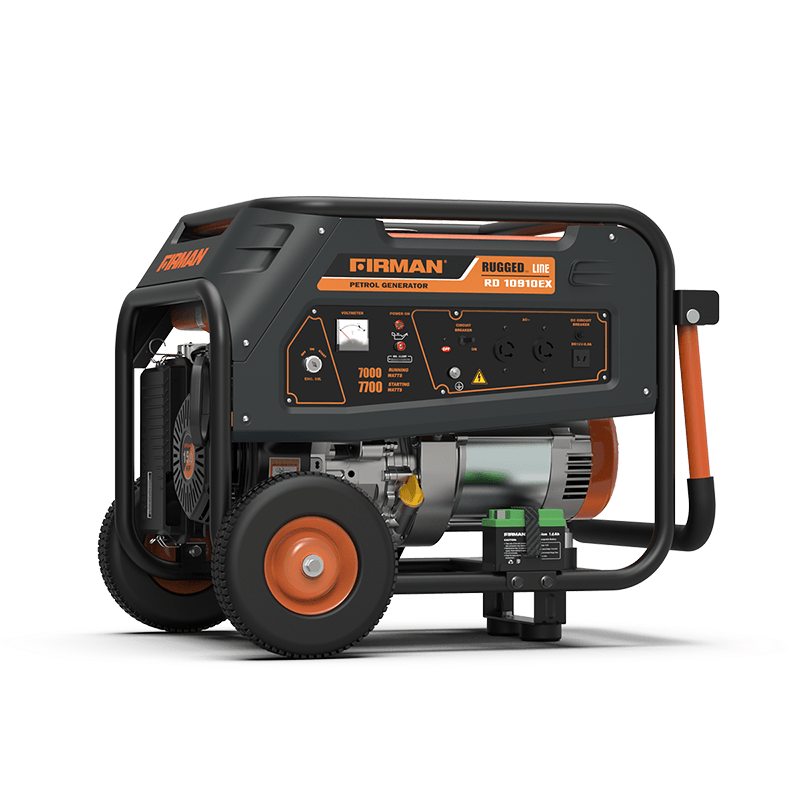
FIRMAN’s RD Series illustrates this type of equipment with its rugged-line design and multiple output levels. The RD8910EX, for example, is listed with 6.6kW starting watts and 6.0kW running watts, weighted 99kg.
Built for convenient transportation and everyday usability, the model features a U-style folding handle, two 11inch never-flat wheels, a reinforced frame, an upgraded control panel, a large muffler, and a high-tech Li-ion battery for key starting. These features can be relevant for buyers who need convenient handling and transportation.
Why Diesel Remains Important for Higher Loads
A diesel generator becomes more compelling when a project calls for higher capacity or more demanding operation,also in the area where diesel price is much cheaper. Meanwhile, owing to the inherently rigid rotational speed–frequency response of the diesel prime mover, the voltage waveform distortion of the generating set can be reliably maintained below 5% THD—a level considerably superior to that of gasoline-driven units. Such enhanced power quality guarantees superior current waveform integrity under non-linear loading conditions, substantially mitigating the risks of protective tripping and forced load derating induced by harmonic contamination.
FIRMAN’s SDG range includes open-type and soundproof models, as well as larger commercial and industrial generator sets. This broader diesel portfolio gives professional buyers options beyond small portable applications.
The SDG8500CLE is a useful example. It provides 6.6 kVA of starting power and 6.0 kVA of running power. It uses a brush, AVR alternator with 100% copper enamelled wire. The model also features an electric starting system, battery, 4 wheels, and open frame construction, weighted 125kg.
The FIRMAN RD8910EX represents a different approach within the same output range. As a gasoline generator, it provides 6.6kW starting watts and 6.0kW running watts while using a brush, self-exciting, synchronous alternator with 2-pole construction and 100% copper enamelled wire. The model is designed for users who value easier transportation and flexible deployment, making it suitable for temporary power needs, outdoor operations, and locations where mobility is a priority.
The SDG18000SE is a useful example. It provides 16.0 kVA of starting power and 14.5 kVA of running power. It uses a brush, AVR alternator with 100% copper enamelled wire. The model also features an electric starting system, battery, 4 pcs of wheels, and a silent canopy, weighted 290kg.
Comparing Portability and Installation Requirements
Portability can strongly influence the gasoline VS. diesel decision. A smaller gasoline unit may be more convenient when equipment needs to be relocated frequently between homes, temporary worksites, or outdoor locations. Buyers should consider frame construction, wheels, handles, starting system, overall dimensions, and weight together.
Diesel equipment can be substantially heavier as output capacity increases. The SDG18000SE, for example, has a gross weight of 290kg and a packing size of 1200×730×880mm. Its silent-canopy configuration is more suited to planned equipment placement than frequent manual relocation.
Fuel Choice Is Only One Part of Operating Cost
Fuel economy matters, but professional buyers should avoid judging total operating cost solely from the fuel used. Purchase price, maintenance requirements, runtime, load profile, transportation, service support, and expected operating hours can all affect lifecycle value.
The most appropriate fuel therefore depends on how the generator will be used. A gasoline unit can make sense for intermittent and mobile applications, while a diesel generator may be more appropriate where higher-capacity equipment is required for demanding workloads. Comparing these factors can provide a more accurate purchasing assessment than focusing on fuel price alone.
What Should Buyers Expect From Power Equipment Manufacturers?
The manufacturer itself deserves careful evaluation. business buyers should look for evidence of product testing, engineering capability, portfolio breadth, and after-sales support. A company serving different applications can potentially provide more suitable options as project requirements change.
FIRMAN’s official brand information states that its models undergo continuous running hour 500-hour testing, including extended continuous testing for new models and temperature-controlled environmental testing. The company also offers larger diesel generator sets as part of its broader generator portfolio.
A Broader Product Range Can Simplify Sourcing
FIRMAN’s current portfolio includes petrol generators, diesel generators, multi-fuel models, inverter generators, engines, water pumps, construction machinery, and renewable-energy products. Its diesel category includes SDG Series and commercial industrial products, while its petrol range covers ECO, RD, SPG, Ruby, FPG, inverter, industrial, and other lines.
This breadth can be valuable for purchasing teams managing different project requirements. Instead of applying the same fuel type to every application, buyers can compare models within one broader equipment ecosystem and select according to output, mobility, environment, and intended workload.
Selecting the Right Generator for the Job
So, which is better: gasoline or diesel? Neither is universally superior. Gasoline generators can be well suited to portable and intermittent applications, while diesel generators can offer a stronger fit for higher-capacity and more demanding projects. The final decision should be based on actual load, operating frequency, fuel costs, mobility, installation conditions, and lifecycle requirements.
For business buyers comparing power equipment manufacturers, FIRMAN provides both petrol and diesel generator options across multiple capacity ranges. The RD8910EX and SDG18000SE demonstrate how significantly generator configurations can differ. Evaluating those differences against the project’s practical needs is the most reliable way to determine which fuel type delivers the better overall solution.
