

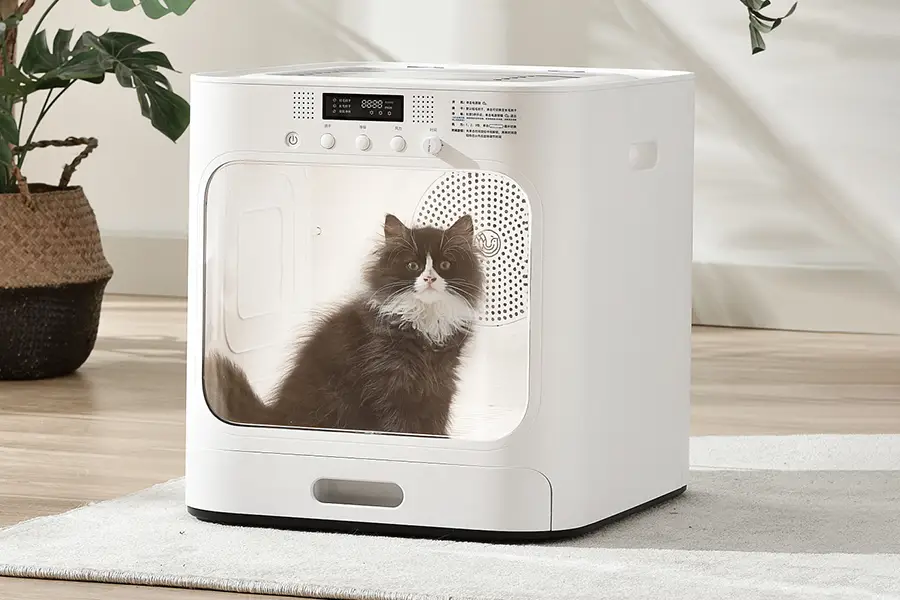
Pet grooming equipment operates in a demanding environment where water, humidity, heat, and repeated cleaning are routine. For manufacturers developing pet grooming cage dryers, the heating system must do more than generate warm air. It needs to support efficient drying while maintaining controlled temperatures and dependable operation over repeated cycles. PTC heating technology is therefore worth considering when equipment designers need a compact, self-regulating heat source for warm-air applications.
Why Moisture Resistance Matters in Pet Drying Equipment
A cage dryer is regularly exposed to moisture because freshly bathed animals enter the enclosure with wet coats. Water droplets and humid air can also remain around the equipment after each drying cycle. If heating components are not appropriately selected and integrated, prolonged exposure to moisture may contribute to corrosion, insulation problems, or electrical reliability issues.
For manufacturers, this means moisture management should be considered during the heating-system design stage. The heater, wiring, enclosure, airflow path, and electrical connections all need to be positioned and protected appropriately for the intended operating environment.
Material selection is another important consideration. Components exposed to humid airflow should have suitable resistance to environmental degradation. The overall equipment design should also prevent unnecessary water contact with electrical parts while allowing sufficient airflow through the heating section.
How PTC Heating Supports Controlled Warm Airflow
PTC heaters use ceramic materials with a positive temperature coefficient. As the temperature of the heating element rises, its electrical resistance increases, naturally limiting power input. This self-regulating characteristic can help reduce the risk of excessive temperature rise compared with conventional resistive heating approaches.
For pet grooming cage dryers, that behavior is particularly useful because the objective is not simply to produce maximum heat. The system needs to deliver warm airflow suitable for drying while maintaining an application-appropriate temperature range. PTC technology can provide rapid heat generation and stable operation without relying entirely on complicated external temperature-control arrangements.
A fan-based PTC heater can combine heat generation and forced airflow in a compact module. Air passing through the heated section transfers thermal energy into the airflow, allowing warm air to circulate around the animal and support more consistent drying.
Designing for Faster and More Reliable Drying
Drying performance depends on more than heater wattage. Air volume, airflow direction, enclosure design, temperature control, and the condition of the animal’s coat all influence the overall drying process. A properly matched heating module should therefore be evaluated as part of the complete airflow system rather than as an isolated component.
For equipment manufacturers, compact heater dimensions can also simplify mechanical integration. A smaller module may provide greater flexibility when designing the air duct, fan chamber, electrical compartment, and service access. This can be valuable when cage dryers need to fit within specific equipment footprints.
The heating system should also provide repeatable performance. Pet grooming businesses may operate dryers many times each day, making component reliability an important consideration for equipment manufacturers and commercial users. Stable heating can help support predictable drying cycles and reduce unnecessary downtime.
Safety Considerations for Pet Grooming Cage Dryers
Pet grooming equipment requires a different approach from many industrial drying systems because the heated airflow is used around living animals. Excessive temperature can create safety concerns, while insufficient heat may extend drying times and reduce equipment productivity.
The self-regulating behavior of PTC elements can provide an additional layer of thermal control. As the element temperature increases, resistance rises and power consumption decreases. This characteristic can help limit uncontrolled temperature escalation, although the complete dryer still requires appropriate airflow management, temperature sensing, electrical protection, and mechanical safeguards.
Manufacturers should validate the complete system under realistic operating conditions. Testing should consider blocked or restricted airflow, continuous operation, ambient humidity, cleaning procedures, and variations in the equipment’s ventilation configuration.
Engineering for Long-Term Operation in Humid Environments
Corrosion resistance should be treated as a system-level requirement rather than a specification applied to the heater alone. The selected heating element must work with suitable housing materials, electrical insulation, connectors, fasteners, and airflow components.
Manufacturers should also consider how condensation could develop during shutdown and temperature changes. Good enclosure design and drainage or ventilation strategies can help limit moisture accumulation. Routine cleaning procedures should likewise be evaluated to ensure that water or cleaning agents are not directed toward sensitive electrical components.
For OEM projects, customization can further improve integration. Voltage, wattage, dimensions, mounting arrangements, and airflow requirements may vary between cage dryer designs. Selecting a heater that can be matched to the equipment’s electrical and mechanical architecture can make development more straightforward.
A Practical PTC Heater Option for Commercial Dryer Design
For manufacturers evaluating pet grooming cage dryers, the PTC Fan Heater from PTCYIDU is presented as a compact option for generating warm airflow after bathing or grooming procedures. Its listed specification is 220V and 400W, with dimensions of 106 × 80 × 53 mm. Custom voltage and wattage are also available, giving equipment developers additional flexibility when matching the heater to a particular dryer design.
The manufacturer, PTCYIDU, operates under Shanghai Yidu Electronics and provides PTC heating products for OEM applications. Its product range includes conductive PTC air heaters, insulated PTC air heaters, fan heaters, aluminum shell heaters, flexible PTC heaters, and other heating products. The company also identifies the pet industry as one of its application areas.
For business equipment developers, this combination of self-regulating PTC heating, compact construction, and configurable electrical parameters can provide a practical starting point for developing durable warm-air drying systems. Proper moisture protection and complete-system testing remain essential, but an appropriately specified PTC fan heater can help balance drying performance, thermal control, and long-term reliability.
