

Material durability studies are only useful when exposure conditions are controlled closely enough to produce interpretable results. Xenon-arc testing can simulate important aspects of sunlight while allowing laboratories to manage irradiance, temperature, moisture, and exposure time. Selecting the right equipment and defining these variables clearly help researchers compare materials, identify degradation patterns, and connect laboratory findings with real product-performance questions.
Start With the Material and Test Objective
A xenon-arc exposure program should begin with the property that needs to be evaluated. Coatings may be assessed for color change, gloss retention, chalking, cracking, or other surface deterioration. Plastics, printing materials, automotive components, and other products can have different durability concerns, so the exposure setup should reflect the intended application.
The test objective also determines which environmental factors need tighter control. A program focused on photodegradation may place greater emphasis on spectral output and irradiance, while another study may need to incorporate moisture or spray conditions. Defining these requirements before selecting equipment helps prevent unnecessary variables from entering the test.
Understand the Role of Xenon-Arc Exposure
Xenon-arc systems are used when a laboratory needs controlled exposure to a spectrum intended to represent solar radiation more closely than a simple ultraviolet source. The actual test result still depends on the selected filter, irradiance level, temperature, moisture conditions, and exposure cycle.
ASTM G155, for example, covers the practice of operating xenon arc light apparatus for exposure of nonmetallic materials, while ISO 4892-2 addresses exposure of plastics to laboratory light sources using xenon-arc lamps. These standards illustrate why exposure equipment should be selected and configured according to the applicable testing method rather than simply by chamber size.
Control Irradiance Instead of Relying on Lamp Power Alone
Lamp power is only one part of the exposure equation. What matters to the specimen is the irradiance delivered at the defined control point. Lamp aging, optical components, filters, and other operating factors can influence the actual energy reaching the sample.
A closed-loop irradiance control system can help compensate for changes in light intensity during operation. The BGD 867 Cabinet Xenon Test Chamber, for example, uses closed-loop control and provides selectable irradiance control at 340 nm, 420 nm, 300–400 nm, or 300–800 nm. The system also allows users to configure exposure parameters through its interface and record operational data.
This type of control is particularly relevant when results need to be compared over extended testing programs. Consistent exposure conditions make it easier to distinguish changes in material behavior from changes in the test environment.
Consider Temperature and Moisture Together with Light
Light is rarely the only factor responsible for weathering. Temperature and moisture can interact with radiation and influence how a material ages. Depending on the test method, laboratories may therefore need to control black panel temperature, black standard temperature, chamber humidity, condensation, or water spray.
The BGD 867, for instance, provides automatic control of relative humidity and black panel temperature and includes a front spray function with adjustable spray and interval times. It can also save programmed procedures, allowing defined exposure cycles to be repeated.
When comparing two materials, keeping these environmental variables consistent is important. Otherwise, apparent differences in durability may partly reflect differences in exposure conditions.
Match Chamber Capacity to Study
Sample capacity should be considered alongside the number of materials, replicates, and evaluations planned for a test program. A chamber that is too small may require separate runs, potentially introducing differences between exposure batches. Larger systems can be useful when multiple specimens need to experience the same cycle simultaneously.
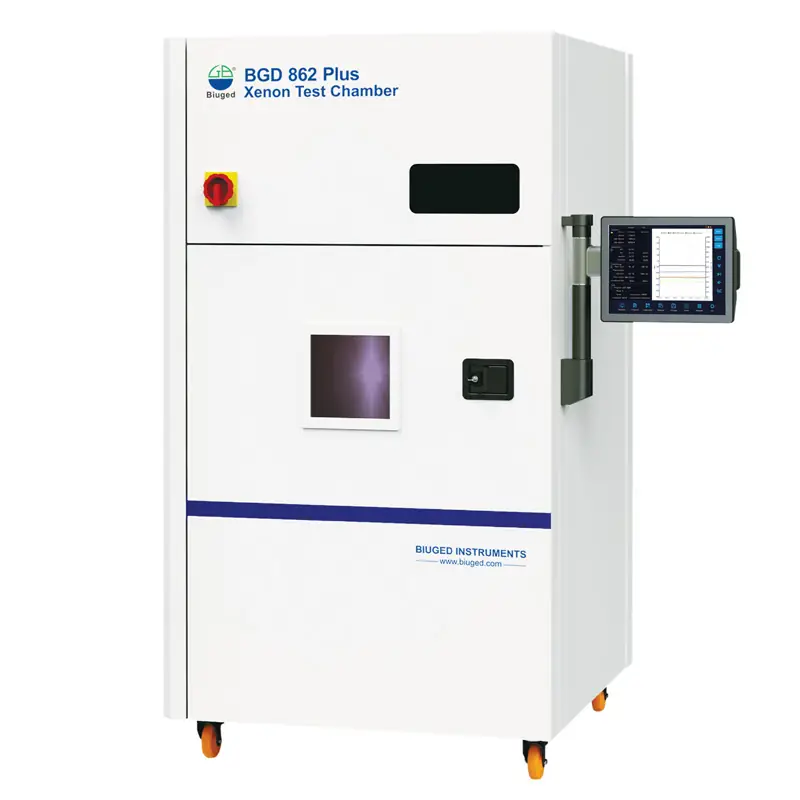
BIUGED INSTRUMENTS lists several xenon testing configurations for different laboratory requirements. Its BGD 867 Cabinet Xenon Test Chamber accommodates 25 standard 150 × 70 mm samples, while the BGD 862 Plus Big Xenon Test Chamber provides an exposure area of 6,500 cm² and uses a 6.5 kW water-cooled xenon lamp.
The appropriate chamber therefore depends not only on current sample volume but also on how the laboratory expects its testing workload to develop.
Thinking About Sample Uniformity and Data Comparability
Even a precisely controlled chamber cannot compensate for inconsistent specimens. Coating thickness, substrate condition, curing history, sample orientation, and surface preparation can all influence weathering results.
A good testing workflow should standardize specimen preparation before exposure begins. Samples should be identified clearly, positioned consistently, and evaluated using defined criteria. Measurements such as color or gloss should also be collected at specified intervals when degradation trends are important.
Data records should include exposure conditions as well as sample information. This makes it easier to understand whether a change in result is associated with the material itself, the test procedure, or a change in equipment conditions.
Evaluate the Equipment Beyond the Chamber
When purchasing a xenon test chamber, laboratories should look beyond the basic lamp specification. Irradiance control, filter options, temperature management, humidity and spray functions, specimen capacity, programming capability, calibration support, and data recording can all influence long-term usability.
It is also useful to check whether the equipment can meet the specific standards used by the laboratory. BIUGED’s xenon equipment portfolio includes systems with configurable exposure parameters and references to international methods covering coatings, plastics, printing materials, and automotive applications.
From Exposure Conditions to Useful Durability Data
A successful xenon-arc study depends on controlling the complete exposure environment rather than focusing on the lamp alone. Clearly defined irradiance, temperature, moisture, sample preparation, and evaluation procedures give laboratories a stronger basis for interpreting material changes.
With experience in precision testing and standards-oriented equipment, BIUGED INSTRUMENTS provides xenon-arc systems for different weathering and material evaluation requirements. Its range includes compact, cabinet, and larger-capacity configurations, giving users options to align chamber design with sample volume and test conditions.
When a laboratory needs to establish a controlled xenon exposure workflow, BIUGED INSTRUMENTS can provide equipment and technical guidance suited to the intended testing application.
