

At the bedside, pneumonia, chronic obstructive pulmonary disease (COPD) exacerbation, pulmonary edema, trauma, and post-extubation weakness can produce similar distress through very different failures of oxygenation or ventilation. In practice, a medical ventilator must support different physiological needs while giving clinicians enough information to judge whether the chosen strategy is working.
High-flow nasal oxygen may be suitable for hypoxemia with preserved spontaneous breathing, whereas non-invasive bilevel support can unload respiratory muscles and improve ventilation in selected patients with hypercapnia.
Some patients require escalation to invasive ventilation when mental status, airway protection, hemodynamics, or gas exchange deteriorates. Multi-mode equipment helps by placing several support options and monitoring channels on one platform, allowing therapy to change as the clinical picture evolves.
The presence of multiple modes does not remove the need for a clear protocol: the team must define treatment goals, reassessment intervals, and failure criteria before starting a medical ventilator. Timely escalation matters because prolonged use of an ineffective non-invasive strategy can delay definitive airway management and worsen outcomes.
The initial approach should also respect patient preference and goals of care, particularly when advanced illness, treatment burden, or a limited likelihood of recovery changes the balance between aggressive escalation and comfort-focused support. These conversations should occur before respiratory distress limits meaningful participation.
Selecting the Mode That Fits the Physiology
High-flow therapy delivers a warmed, humidified oxygen-air mixture at a flow sufficient to meet inspiratory demand, wash out upper-airway dead space, and provide a modest pressure effect. Non-invasive ventilation adds defined inspiratory and expiratory pressures, making it more appropriate when respiratory-muscle unloading or carbon-dioxide clearance is required.
CPAP can recruit alveoli and support oxygenation in specific settings, while S, T, S/T, and pressure-control modes offer different relationships between spontaneous effort and timed assistance. A new cpap device may include monitoring and automatic comfort functions, but it should not be confused with a clinical platform designed for rapidly changing respiratory failure.
Likewise, a new cpap device marketed for home sleep therapy cannot be assumed to provide the alarms, oxygen handling, proximal sensing, or multi-parameter review required at the bedside.
Mode selection should be guided by respiratory rate, work of breathing, blood gases, oxygen saturation, consciousness, secretion burden, mask tolerance, and the underlying diagnosis. Reassessment during the first hour is especially important because early improvement or decline often determines the next step.
Interface choice influences both efficacy and tolerance: staff should consider facial anatomy, mouth leak, skin condition, aspiration risk, secretion load, and the ability to summon help before committing to prolonged non-invasive treatment. Frequent skin inspection and planned breaks can prevent avoidable interface injury.
Integrated Monitoring Supports Faster Reassessment
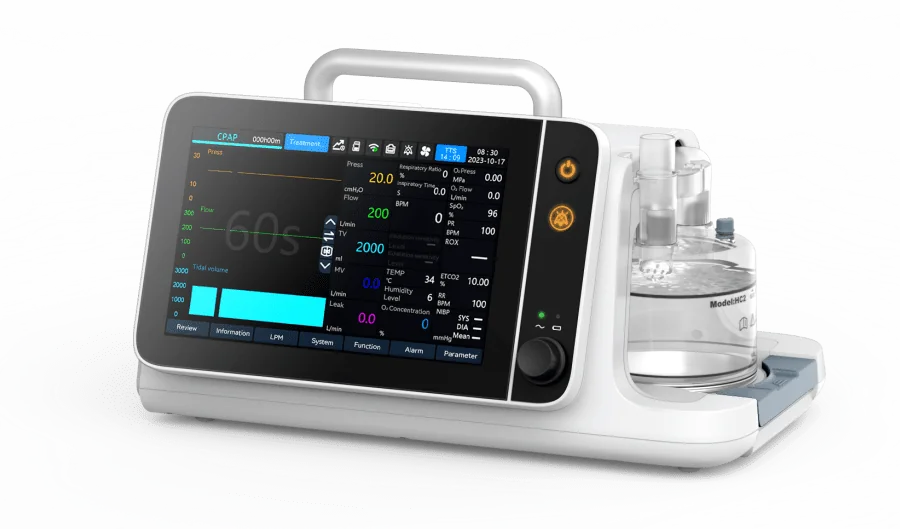
For acute-care teams, the ResAero series from Beyond can reduce the need to switch between separate devices by keeping non-invasive ventilation (NIV), high-flow nasal cannula (HFNC), and synchronized nebulization on one platform. Its title-relevant benefit is continuity: high-flow delivery can reach 80 L/min with heated humidification, after which the same unit can move to CPAP, S, T, S/T, or APCV with leakage compensation.
Instead of forcing staff to reconstruct an episode from separate screens, Beyond presents pressure and flow beside ventilation, leakage, respiratory, oxygenation, pulse, ROX, and VOX trends on a 10.1-inch display.
The system accepts both high-pressure central oxygen and low-pressure concentrator input, which can broaden use across clinical environments. Proximal pressure sensing and voice alarms add bedside awareness, while a dedicated nebulizer port can coordinate aerosol treatment with high-flow or non-invasive support.
AI-assisted control can track the ROX index and oxygen saturation and adjust delivery under high-flow treatment. Clinical decisions can use these organized data without reducing the patient’s trajectory to a single index; examination findings, laboratory results, and imaging still determine the broader interpretation.
Optional parameters such as end-tidal carbon dioxide and non-invasive blood pressure can broaden assessment when clinically appropriate, but added sensors should be selected for a defined decision rather than attached simply because the platform supports them. Each added metric should correspond to an anticipated bedside decision or escalation.
Protocols Turn Versatility into Clinical Value
Versatility becomes clinically useful only if staff can operate the platform consistently under pressure. For each therapy pathway, hospitals should define interfaces, initial settings, oxygen targets, humidification checks, skin-protection measures, secretion management, alarm limits, and infection-control procedures.
Scenario-based training can rehearse transitions between high flow and non-invasive support, recognition of worsening fatigue, and preparation for intubation when failure criteria are met. The reason for every mode change and the patient’s response belong in the clinical record so that later shifts inherit a coherent timeline.
Readiness also depends on having circuits, masks, cannulas, nebulizer components, filters, backup power, and oxygen connections available before an emergency. A review after use looks at response time, unplanned escalation, alarm patterns, interface complications, and protocol adherence.
Versatility reduces transfers between machines, but it cannot justify a familiar mode after the physiology has changed. Acute respiratory support remains a sequence of time-sensitive decisions, and technology earns its place by making those decisions clearer, safer, and easier to execute.
Debriefing difficult cases across disciplines can expose delays, unclear responsibilities, equipment gaps, and communication failures that are invisible in device logs, turning individual experience into a safer and more reproducible respiratory pathway. Multidisciplinary learning also strengthens coordination during the next urgent transition.
