

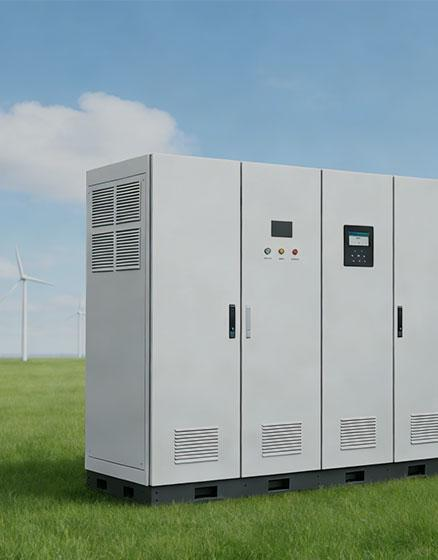
Battery storage spends much of its operating life away from nameplate power. Charging may follow available solar generation, discharge may track a changing facility load, and reserve requirements can keep output relatively low for long periods. For that reason, the efficiency of a silicon carbide inverter cannot be judged only at full load.
Partial-load losses accumulate over thousands of operating hours and affect how much stored energy reaches the AC side. In an energy storage inverter, the efficiency curve across the operating range can matter as much as one peak value.
Efficiency Curves Matter More Than One Peak Number
Every converter has fixed and variable losses. Control electronics, auxiliary power supplies, cooling equipment, magnetics, and semiconductor switching all consume or dissipate energy, but their contribution changes with output power.
At high load, conduction losses become more prominent because current is larger. At light load, fixed auxiliary consumption and switching-related losses can represent a larger share of transferred energy.
A silicon carbide inverter is relevant because SiC devices can switch with lower losses than many conventional silicon devices under suitable design conditions, giving engineers more room to maintain favorable conversion efficiency over a wider operating region rather than optimizing only one rated point. This distinction matters in daily-cycling storage.
A system may charge gradually, remain near standby, then discharge at a moderate rate during a tariff peak. If losses rise sharply below rated output, annual conversion loss can exceed what a peak-efficiency figure suggests. Real performance therefore needs to be judged against the expected duty cycle.
Why Partial-Load Losses Accumulate Over Time
The electrical behavior of an energy storage inverter changes as current and switching conditions change. Semiconductor conduction losses generally rise with current, while switching losses occur repeatedly whenever power devices change state.
SiC technology can reduce the switching-loss penalty in many converter designs, which is useful when the equipment operates through frequent changes in charge and discharge power. Lower device loss also means less heat must be removed from the power stage, although the complete thermal result still depends on topology, cooling, magnetics, and enclosure design.
Partial-load efficiency matters because small differences can repeat every day. A battery system that spends far more hours at 20–60% output than at 100% output will experience most of its lifetime conversion under those intermediate conditions.
The effect is not only an electricity-cost issue. Energy lost as heat cannot be delivered to the load, so conversion efficiency influences usable AC energy from each stored kilowatt-hour and also affects the cooling burden placed on the cabinet.
From Device Losses to Usable Stored Energy
Across a full charge-discharge cycle, energy is converted while the battery charges and again when it discharges to an AC network, so losses on both paths reduce round-trip energy available to the site. Better mid-range efficiency is especially relevant for systems that rarely reach rated power.
A silicon carbide inverter can reduce part of the power-stage loss, while battery efficiency, transformers, cables, auxiliaries, and control strategy remain part of the total balance. Inverter efficiency is not identical to system efficiency.
Even a highly efficient converter cannot compensate for an oversized transformer operating poorly at light load or unnecessary auxiliary consumption. The conversion stage is one contributor within a chain of electrical losses, so expected load profile and the complete power path both matter.
System Architecture Determines Whether the Advantage Is Useful
WidenEdge treats storage conversion, DC conversion, and local coordination as linked functions within one full-SiC microgrid platform: MGC storage inverters share the architecture with PV/DC and EV/DC stages and Hub controllers.
Projects can range from ordinary grid-connected operation to weak-grid, off-grid, and hybrid conditions, exposing the storage inverter to very different demand and generation profiles rather than one fixed operating point. Within such an arrangement, an energy storage inverter is repeatedly asked to move between different power levels as local demand and generation change.
SiC power conversion can be valuable in that operating pattern because efficiency, thermal loading, and dynamic control are considered together rather than as isolated specifications. The same principle applies to project sizing. A converter that is oversized for most of its duty cycle may spend long periods in a low-load region where fixed losses are proportionally more significant.
A smaller unit operating closer to its efficient range may reduce those losses, but it must still satisfy peak load, overload, redundancy, and expansion requirements. Equipment efficiency therefore needs to be evaluated together with system sizing and operating strategy.
Lifetime Energy Use Is the More Useful Measure
A storage project ultimately pays for energy that can be stored, converted, and used over years of operation. Peak efficiency remains useful, but it is only one point on a much wider operating curve.
The more variable the duty cycle, the more relevant partial-load performance becomes. A silicon carbide inverter can reduce conversion losses across useful portions of that range, while the surrounding electrical design determines how much of the theoretical advantage is retained in practice.
For an energy storage inverter serving changing loads, the better question is not only how efficiently it works at rated power, but how much energy it preserves through the operating conditions the site actually experiences.
SEO Title: How Silicon Carbide Inverters Improve Efficiency Across Different Load Conditions | WidenEdge
Meta Description: Read our latest insights on How Silicon Carbide Inverters Improve Efficiency Across Different Load Conditions. Explore partial-load losses and energy use.
