

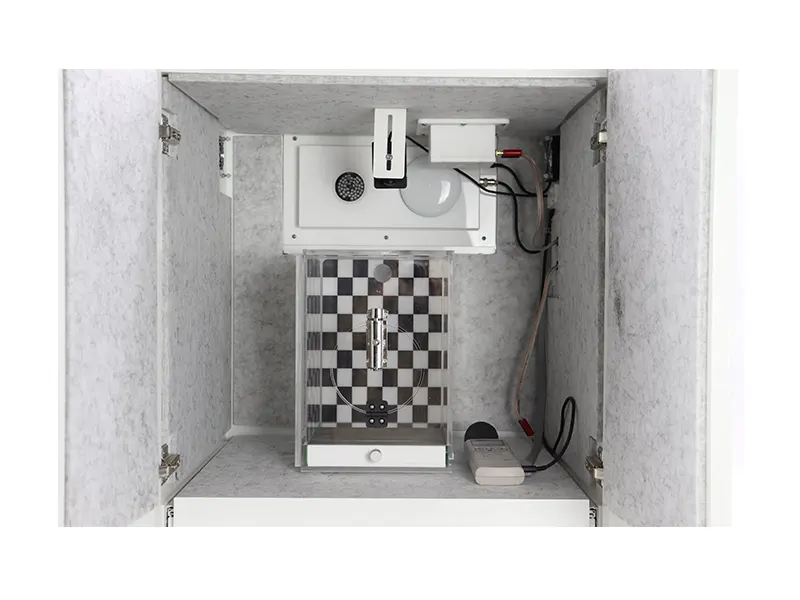
Fear conditioning experiments are widely used in behavioral neuroscience to investigate learning, memory formation, and emotional processing in rodents. However, contextual and cued fear conditioning are designed to evaluate different forms of associative learning. Selecting the appropriate paradigm requires researchers to consider the memory mechanism being studied, experimental procedures, behavioral scoring methods, and system capabilities. BioMed Easy develops life science instruments and software solutions that support animal behavior and neuroscience research.
Defining the Research Question Before Designing a Fear Conditioning Experiment
Before establishing a fear conditioning protocol, researchers need to determine which type of memory process they want to evaluate. Contextual and cued paradigms involve similar conditioning principles, but they provide different insights into how animals learn and recall aversive experiences.
Contextual fear conditioning evaluates whether animals can associate an entire environment with an aversive event. The chamber itself becomes an important part of the memory process, requiring animals to recognize and respond to environmental features. This model is frequently used in studies related to hippocampal function, cognitive impairment, and memory formation.
Cued fear conditioning focuses on the association between a specific sensory signal and an aversive stimulus. The sensory signal is usually a controlled cue, such as an auditory tone or visual stimulus. This approach is commonly applied in studies of emotional learning, amygdala-related pathways, and fear response mechanisms.
Designing Contextual and Cued Fear Conditioning Protocols
Although both paradigms involve conditioning and memory testing, their experimental designs require different considerations.
During contextual fear conditioning training, animals learn that a specific environment is connected with an aversive stimulus. Therefore, chamber conditions, background features, odors, and other environmental factors must remain consistent. During testing, animals are returned to the same environment, and their behavioral response reflects recognition of the context.
In cued fear conditioning, animals learn that a particular signal predicts an aversive event. The timing, duration, and intensity of the cue are critical because variations may influence learning outcomes. During testing, researchers present the cue separately to evaluate whether animals remember the learned association.
The differences between these protocols mean that experimental parameters must be carefully designed according to the memory process being investigated.
Behavioral Scoring: Measuring Fear Responses Accurately
Behavioral scoring is a key component of fear conditioning studies because it determines how researchers quantify learning and memory performance.
Freezing behavior is one of the most commonly measured responses in both contextual and cued fear conditioning experiments. The duration or percentage of time spent freezing is often used as an indicator of fear memory strength.
However, the interpretation of freezing data depends on the experimental paradigm. In contextual testing, freezing reflects the ability to remember the association between the environment and the aversive stimulus. In cued testing, freezing indicates recognition of a specific learned signal.
Manual observation can introduce differences between researchers, especially in studies involving multiple groups or repeated experiments. Automated behavioral analysis systems can help improve consistency by providing objective measurement and reducing scoring variation.
What Makes a Fear Conditioning System Suitable for Neuroscience Research?
A reliable fear conditioning system should support accurate stimulus control, stable experimental conditions, and efficient behavioral recording.
Environmental control is especially important for contextual experiments because changes in chamber conditions may affect memory evaluation. Consistent lighting, chamber design, and background conditions help researchers maintain repeatable testing environments.
For cued experiments, precise stimulus delivery is essential. The system should provide reliable control over cues, including timing and intensity, to ensure that differences in behavior are related to experimental factors rather than technical variation.
Behavior recording capability is another important consideration. Clear video monitoring and automated freezing detection can improve data accuracy and simplify analysis, particularly for laboratories conducting large-scale behavioral studies.
Choosing a Fear Conditioning System for Different Research Applications
Researchers selecting a fear conditioning system should consider whether the equipment can support different experimental designs and provide reliable behavioral measurements.
Protocol flexibility is important because neuroscience laboratories may investigate various learning and memory mechanisms. A suitable system should allow researchers to conduct both contextual and cued experiments while maintaining consistent experimental conditions.
Measurement reliability is also essential. Accurate freezing detection and stable data collection help researchers compare results between control and experimental groups.
The Fear Conditioning System from BioMed Easy is designed for rodent behavioral neuroscience studies involving learning and memory evaluation. It supports controlled experimental procedures and behavioral analysis for research applications related to fear responses and associative learning.
For laboratories conducting contextual fear conditioning, selecting a system with reliable environmental control and behavioral measurement capabilities can help improve experimental consistency.
Selecting the Appropriate Fear Conditioning Paradigm for Research Goals
Contextual and cued fear conditioning are designed to investigate different aspects of associative learning, so the selection of a suitable paradigm depends on the biological process researchers aim to understand.
When the research focuses on how animals recognize and remember environmental information, contextual fear conditioning provides valuable insights. Because the entire experimental environment becomes part of the learned association, this approach is often used in studies related to hippocampal function, memory formation, and cognitive impairment.
In contrast, cued fear conditioning is more focused on the relationship between a specific sensory signal and an aversive event. This makes it useful for investigating emotional learning, cue-related responses, and neural circuits involved in fear processing.
For studies that require a broader evaluation of learning mechanisms, researchers may combine both paradigms. Comparing contextual and cue-based responses can provide a more comprehensive understanding of how different brain regions contribute to memory formation and fear behavior.
When designing a contextual fear conditioning experiment, researchers should consider the target memory process, behavioral endpoints, and experimental system capabilities to ensure that the selected protocol matches the scientific objective.
Establishing Reliable Fear Memory Research Workflows
Contextual and cued fear conditioning are complementary approaches rather than competing methods. Each paradigm provides different information about learning and memory, and the most suitable choice depends on the biological mechanism being studied.
Reliable results require appropriate experimental design, consistent behavioral scoring, and equipment that supports accurate stimulus control and data collection.
BioMed Easy specializes in life science instruments and software for animal behavior, neuroscience, pharmacology, and physiological research. Its Fear Conditioning System supports controlled behavioral experiments for universities, research institutions, CROs, and pharmaceutical companies, helping researchers establish reliable workflows for fear memory and behavioral neuroscience studies.
