

Structural deformation during thermoplastic cooling remains a critical challenge for industrial optics engineers. Producing high-volume plastic frame sunglasses requires tight control over resin shrinkage, thermal gradients, and mold pressure to keep frame geometry true. When polymer molecules realign unpredictably during cooling, internal stress causes twisting, lens popping, and bridge misalignment.
Navigating these thermodynamic properties demands a detailed understanding of material behavior, tooling mechanics, and post-mold processing. B2B buyers evaluating commercial eyewear lines benefit from recognizing how precision manufacturing prevents dimensional drift. Structural integrity ensures optical alignment and long-term durability across diverse environmental conditions.
Polymer Crystallinity and Thermal Shrinkage Dynamics
Thermoplastic resins undergo microscopic orientation changes as liquid polymer transforms into a solid structure. Semi-crystalline materials shrink unevenly along flow channels compared to transverse directions, creating differential internal tension. Amorphous polymers like polycarbonate exhibit lower volumetric shrinkage but store high residual stress if cooled prematurely.
Controlling molecular alignment inside the mold cavity prevents warpage before the component ejects. Engineers adjust barrel temperatures, injection speed profiles, and holding pressures to yield uniform density distribution. Achieving balanced density minimizes localized warping across delicate front rims and temple connections.
Mold Design Factors Influencing Frame Deformation
Tooling architecture dictates how molten resin flows through runners and enters the frame cavity. Poorly positioned gates force hot polymer to travel uneven distances, creating pressure drops and uneven cooling rates. Toolmakers use balanced runner systems and uniform cooling channels to maintain steady temperatures across complex contours.
Incorporating conformal cooling channels follows the physical geometry of curved eyewires and bridges. Circulated fluid absorbs heat evenly from thick and thin sections alike. Strategic thermal control reduces differential cooling rates, keeping the underlying chassis stable after ejection.
Material Selection: TPEE and Advanced Polymers
Selecting flexible thermoplastics like Thermoplastic Polyester Elastomer (TPEE) provides exceptional mechanical resilience and warpage resistance. Unlike rigid materials that crack under mechanical stress, TPEE absorbs impact while retaining its original form factor. This flexibility suits active eyewear applications where impact resistance and shape memory are essential.
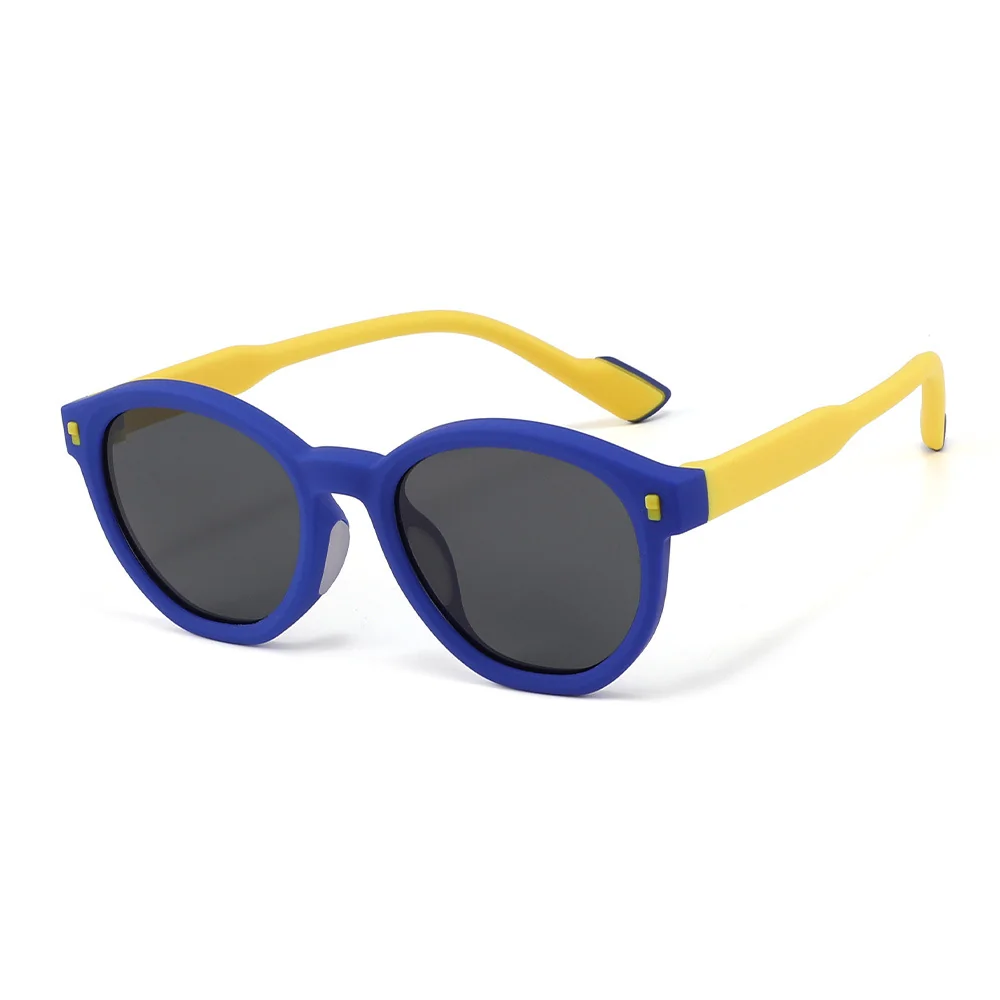
Specifications like those found in Bulk Flexible TPEE Frame Kids Polarized Sunglasses demonstrate how material selection supports stability. Built with a 45-18-126 sizing profile, these frames utilize TPEE to offer bendable comfort for wearers aged three to eight. The material’s elastic memory allows frame arms to flex without permanent structural deformation.
Optimizing Injection Molding Parameters
Precision control over machine parameters prevents internal stress accumulation during processing cycles. Injection speed determines shear stress levels, while holding pressure compensates for natural material shrinkage as the plastic freezes. Insufficient holding pressure leads to sink marks, whereas excessive pressure creates mold packing stress.
Monitoring cavity pressure curves via piezoelectric sensors gives technicians real-time control over part consistency. Adjusting pack time according to gate freeze times stabilizes mechanical properties. Fine-tuning these thermal parameters preserves dimensional stability across entire production runs.
Optical Integration and Lens Fit Considerations
Dimensional stability directly impacts how securely protective optical lenses sit within the frame bevel. Warped eyewires create non-uniform groove depth, causing polarized or tinted lenses to pop out under minor torsional stress. Maintaining exact rim circumferences guarantees proper mechanical retention without distorting optics.
Pairing stable TPEE frames with TAC polarized lenses providing UV400 protection yields a durable, protective eyewear solution. Uniform groove dimensions keep polarized films aligned, protecting vision without optical distortion. Precise rim geometry keeps protective lenses firmly seated during rigorous daily activity.
Post-Molding Annealing and Stress Relief
Thermal annealing involves subjecting molded components to controlled heating cycles below their glass transition temperature. This secondary processing step allows trapped molecular chains to relax, releasing internal stress induced during injection. Annealing significantly reduces long-term warpage caused by ambient temperature fluctuations.
Placing components into customized cooling fixtures immediately after ejection preserves precise geometric shapes. Restraining the frame chassis while it drops below heat deflection temperatures fixes critical angles like bridge pantoscopic tilt. Secondary fixture cooling secures dimensional accuracy across mass production batches.
Specialized Testing and Quality Control Procedures
Verifying dimensional accuracy involves subjecting sample batches to stringent mechanical and environmental testing protocols. Dimensional accuracy is verified through rigorous inspections at each production stage, with frame profiles checked against CAD specifications to maintain consistent tolerances. Environmental test chambers expose products to high humidity and temperature swings to test warpage resistance.
Quality assurance protocols implemented by JHEYEWEAR include sweat resistance, hinge fatigue, and physical impact evaluations. Testing confirms compliance with European CE and US FDA safety requirements. Certified testing protocols give global buyers confidence in product reliability and structural integrity.
Scalable OEM and ODM Customization Capabilities
Scaling specialized thermoplastic designs into commercial collections requires adaptable manufacturing setups. Factory facilities supporting both OEM and ODM workflows allow buyers to customize frame colors, logo placements, and packaging options. Low MOQ thresholds accommodate niche market testing alongside large-scale retail orders.
Production options at JHEYEWEAR include ready-stock wholesale starting from 300 pieces, while complete OEM/ODM customization projects range from 300 to 600 pieces per style. Access to expansive style portfolios spanning optical frames, reading glasses, and eco-friendly options streamlines catalog expansion. Integrated production capabilities support efficient order turnaround for international distributors.
Environmental Sustainability and Materials Traceability
Adopting eco-friendly polymers introduces distinct processing considerations for maintaining structural stability. Recycled materials, such as GRS-certified recycled polycarbonate (R-PC) and recycled polyethylene terephthalate (R-PET), require refined processing controls to handle variations in melt flow index. Modern processing equipment adapts to recycled resin characteristics without sacrificing dimensional tolerances.
Operating under certified ISO 9001, BSCI, SEDEX, and GRS protocols ensures complete supply chain traceability from raw resin sourcing to finished product packaging. Environmental compliance meets global buyer demands for sustainable manufacturing practices. Traceable material sourcing protects brand integrity across regulated international markets.
Conclusion
Preventing thermal warpage in high-volume production requires balancing polymer rheology, mold cooling mechanics, and precise parameter management. Sourcing from JHEYEWEAR offers B2B buyers access to flexible TPEE frame manufacturing, rigorous quality control, and certified sustainable options. Applying advanced processing techniques allows optical brands to supply durable, dimensionally stable plastic frame sunglasses to international markets.
