

Carbon monoxide (CO) and carbon dioxide (CO₂) are both common in industrial environments, but they present different monitoring challenges. CO is a toxic, colorless, odorless gas produced by incomplete combustion, while CO₂ can accumulate in poorly ventilated areas and displace breathable air. Both can become serious hazards when concentrations rise unexpectedly.
Industrial facilities therefore need a monitoring strategy based on their processes, equipment, ventilation, and work areas. A suitable Gas Detector can help workers identify changing atmospheric conditions and support safer operation, inspection, and maintenance.
Understanding the Difference Between CO and CO₂
Carbon monoxide is primarily associated with combustion. Industrial sources can include forklifts, engines, generators, furnaces, boilers, and other equipment that burns carbon-containing fuels. Because CO has no reliable warning odor, workers may be exposed without realizing that a problem exists.
Carbon dioxide behaves differently. It is naturally present in the atmosphere and is also widely used in industrial processes. It can accumulate through combustion, fermentation, beverage production, dry ice use, or the release of compressed CO₂.
CO₂ is particularly important in enclosed or poorly ventilated spaces. Elevated concentrations can affect breathing and may contribute to unconsciousness at very high levels. Because CO₂ is colorless and odorless, visual or sensory observation cannot reliably indicate whether an area is safe.
Where Should Industrial Facilities Monitor CO?
CO monitoring should focus on areas where combustion equipment operates or where exhaust gases could enter occupied spaces. Common examples include engine rooms, boiler areas, workshops, warehouses using fuel-powered equipment, loading areas, and enclosed maintenance spaces.
Facilities should also consider temporary activities. Running generators indoors, operating engines near doors or ventilation openings, or performing maintenance on combustion equipment can change local gas conditions. Portable monitoring can be useful when workers move between different locations.
A Gas Detector designed for CO can provide direct readings and alarms instead of relying on assumptions about ventilation. This is particularly valuable when workers enter areas where combustion sources are operating or where airflow may change.
Where Can CO₂ Become a Hazard?
CO₂ monitoring requires a different risk assessment. Food and beverage facilities may use CO₂ during carbonation, beverage processing, fermentation, or refrigeration-related activities. Dry ice can also release CO₂ as it changes from a solid to a gas.
Confined and semi-enclosed areas deserve special attention because released CO₂ can accumulate when ventilation is inadequate. Storage areas, production rooms, fermentation spaces, beverage facilities, and enclosed process areas may therefore require monitoring based on the specific application.
The U.S. Environmental Protection Agency notes that indoor CO₂ measurements can provide useful information about ventilation, although readings need to be interpreted according to the specific environment.
Choosing the Right Gas Detector
Selecting detection equipment should start with identifying which gas or combination of gases presents a realistic risk. Facilities monitoring only CO may prefer a single-gas instrument, while operations facing several atmospheric hazards may benefit from a multi-gas configuration.
Sampling method is another consideration. Diffusion-based instruments can be convenient for personal monitoring, while pump sampling can help collect air from locations that are difficult or unsafe to access directly.
Alarm functions are equally important. Audible, visual, and vibration alerts can give workers multiple ways to recognize an abnormal reading. Buyers should also review the required detection range, operating temperature, humidity, enclosure protection, certification, battery performance, and sensor life before selecting a detector.
Portable Detection for CO and CO₂ Applications
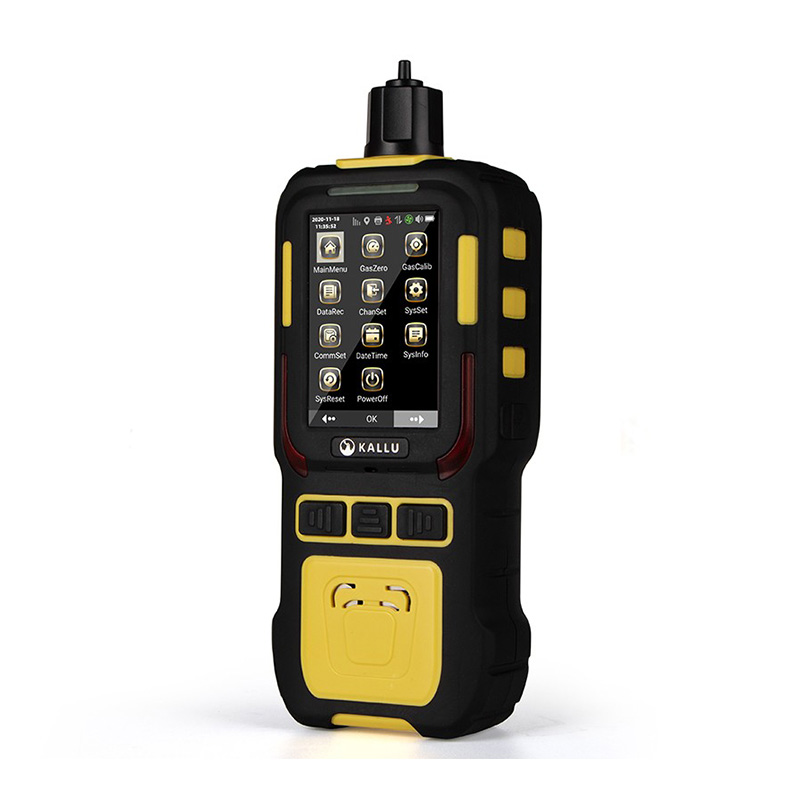
The portable gas detector range includes single-gas and multi-gas instruments for different industrial monitoring requirements. Among them, the K-600 marine 5-in-1 multi-gas detector is an ideal choice for applications requiring the simultaneous monitoring of multiple hazardous atmospheric gases.
The K-600 Marine uses a gas pump sampling method and has a stated accuracy of no more than ±5% F.S. Its response time is no more than 30 seconds. The product provides real-time LCD readings together with LED, audible, and vibration alerts for gas leakage, faults, and low voltage.
Its specifications list an operating environment of -20°C to 50°C and below 95% RH without dew. The detector uses a 3.7 V, 3200 mAh lithium battery, provides at least eight hours of continuous operation without alarming, and has a stated sensor life of two years.
The K-600 Marine also has an Ex ib IIC T4 Gb explosion-proof grade and IP65 protection rating. Its approximate weight is 400 g with the battery, while dimensions are 130 mm × 67 mm × 30 mm. Buyers should confirm the exact sensor combination and measurement ranges required for their application before ordering.
Build Monitoring Into Industrial Safety Procedures
Gas detection should operate as part of a broader atmospheric safety program. Facilities should identify emission sources, maintain ventilation systems, inspect combustion and gas-handling equipment, establish alarm response procedures, and train workers to recognize changing conditions.
Detector maintenance is also essential. Calibration, functional checks, charging, sensor replacement, and inspection should follow the manufacturer’s instructions. Records can help organizations track equipment condition and identify when servicing is required.
For B2B buyers, equipment selection should also consider project requirements. OEMs, distributors, system integrators, and industrial end users may need different configurations, certifications, quantities, or customization options.
About Bosean
Bosean provides intelligent sensing products and solutions across gas detection, environmental monitoring, radiation detection, professional measurement, and thermal imaging. The company supports OEM, ODM, OBM, distributor, system integrator, and project-based cooperation, with an emphasis on precision, reliability, customization, responsive service, and regulatory requirements.
For facilities evaluating CO or CO₂ monitoring, “Contact Us” to discuss the application, required gases, and suitable Gas Detector configuration. Contact Us to confirm product specifications and cooperation requirements before deployment.
