

Speed and torque aren’t the only factors to consider when deciding between a traditional servo motor and a frameless torque motor. It dictates the motor’s joint clearance, the amount of gearbox hardware needed, and the amount of room for structural components, wiring, and encoders.
Engineers working on collaborative robots, humanoid platforms, and precision automation equipment face this decision repeatedly. Understanding what each motor type actually delivers, beyond the datasheet entries, determines whether the final machine meets its torque, accuracy, and packaging targets.
The Structural Difference That Changes Everything
A conventional servo motor arrives as a complete, self-contained unit. It includes a housing, bearings, end caps, and often an integrated feedback device — all surrounding the rotor and stator.
This packaged approach simplifies procurement and replacement, but it imposes a fixed geometry on the machine designer. The motor occupies a defined cylindrical volume, and everything else must fit around it.
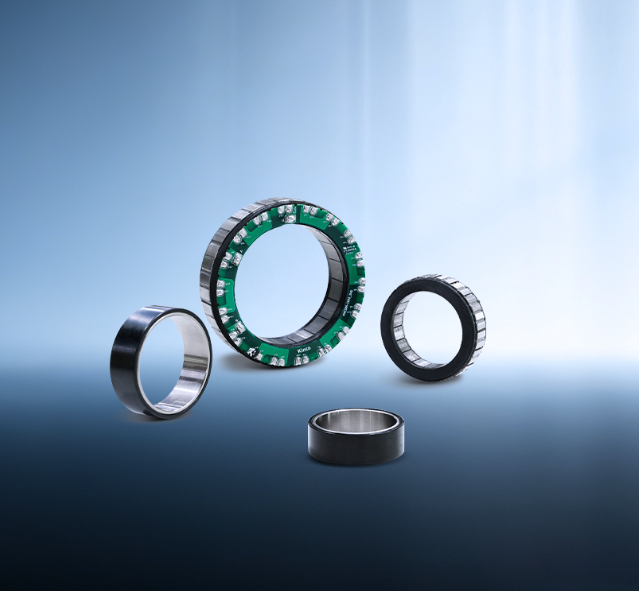
A frameless torque motor abandons this convention entirely. It consists only of a rotor and a stator — no housing, no end caps, no integrated bearings. The machine’s own structure provides the support and containment.
This is why the term “frameless” is literal: the motor has no frame of its own. The stator integrates directly into the joint housing, and the rotor mounts onto the shaft. The mechanical structure of the robot becomes the motor’s enclosure.
This structural difference drives every subsequent performance distinction. Without a housing, the motor occupies less volume for the same active magnetic material. Because the bearings are selected and integrated at the joint level rather than built into the motor, designers can optimize the bearing arrangement for the specific mechanical architecture.
Without end caps, cable routing through the motor center becomes straightforward — a critical advantage in robotic joints where wires for power, signals, and cooling must pass through.
What the Numbers Actually Say About Performance
The torque density comparison between these two motor types reveals a significant gap. A frameless torque motor can offer substantially higher torque density than a conventional housed servo motor within a comparable installation envelope.
In practical terms, a frameless motor with a given outer diameter produces considerably higher continuous torque than a housed servo of similar frame size. This is the defining advantage of the high torque density motor architecture.
Several factors create this gap. First, the elimination of the housing allows more copper and magnetic material within the same envelope. Second, frameless torque motors typically have higher pole counts and larger diameters relative to their length. They run at lower speeds than servo motors but deliver much higher torque.
This torque-at-low-speed characteristic is exactly what robotic joints require — high holding torque, smooth rotation at modest velocities, and the ability to drive the load directly.
Conventional servo motors take the opposite approach. They have smaller diameters, run at higher speeds, and produce lower torque. To achieve the torque needed for a robot joint, a servo motor requires a gearbox — typically a harmonic drive or planetary reducer.
The gearbox multiplies torque but introduces backlash, compliance, friction, and additional weight. The system becomes larger, less responsive, and more complex to control.
The Kinco FMK series illustrates what high torque density motor design achieves in practice. The platform delivers rated torque from 0.063 Nm up to 3.5 Nm across frame sizes from 25 mm to 115 mm outer diameter.
The mechanical time constant — a measure of dynamic responsiveness — reaches as low as 0.068 ms in some models. These specifications reflect the fundamental advantage of the frameless approach: more torque, faster response, in less space.
Where Each Motor Type Belongs
The selection between these motor types depends on the application’s priorities, not on a universal superiority of one over the other.
Conventional servo motors remain the right choice when standardization, interchangeability, and simplified supply chain matter most. If the application can tolerate a gearbox, if space is not severely constrained, and if the machine design does not demand direct integration of the motor into the structure, a packaged servo motor offers convenience and proven reliability. The motor arrives ready to mount, with bearings and feedback already installed. Replacement is straightforward.
Frameless torque motors excel where every millimeter of space matters, where weight reduction is critical, and where direct drive eliminates the performance penalties of mechanical transmission. Robotic joints — particularly in collaborative robots, humanoid robots, and exoskeletons — demand exactly these characteristics.
The motor must fit within the joint envelope, contribute minimal weight, and deliver torque directly to the load without backlash or compliance from gears.
The FMK series addresses the robotic joint application specifically. Its large hollow bore design accommodates complex cable routing through the joint center. This is not a minor convenience — in humanoid robots with dozens of joints, the ability to pass wires, cooling lines, and signal cables through the motor center determines whether the mechanical design is even feasible. The eight standard frame sizes, ranging from 25 mm to 115 mm outer diameter, cover the joint requirements from fingers to hips and shoulders.
The Integration Advantage in Robotic Systems
Beyond the raw torque density numbers, the frameless motor offers a system-level advantage that conventional servo motors cannot match: integration into the machine structure. When the motor becomes part of the joint, the overall assembly shrinks. The machine eliminates the motor housing, the gearbox, the coupling, and the associated mounting hardware.
This integration delivers measurable benefits in robotic systems. When used in a direct-drive architecture, the motor eliminates mechanical backlash associated with a gearbox — there are no gears to introduce play. Response speed improves significantly, with high-precision control achievable through appropriate encoder selection and servo tuning.
The system exhibits lower reflected inertia, higher back-drivability, and superior force control bandwidth. These characteristics are essential for collaborative robots that must interact safely with humans and for humanoid robots that require agile, natural movement.
The FMK platform supports this integration philosophy comprehensively. The motor family serves both rotary and linear joint modules in full-size humanoid robots. The combination of the FMK frameless torque motor with the RD series hollow driver creates a joint solution that addresses the industry’s demands for low temperature rise and low noise.
Thermal rise suppression — a key design improvement in the fourth-generation FMK series — enables long-duration continuous operation without performance degradation.
Making the Choice
The decision between a frameless torque motor and a conventional servo motor ultimately rests on whether the application prioritizes integration and torque density or standardization and simplicity.
For robotic joints with strict space, weight, and torque requirements, this integration can make the difference between a workable joint design and an oversized one. The FMK series from Kinco demonstrates what this architecture enables: compact, torque-dense actuation that integrates seamlessly into the machine it powers.
That integration is not merely a packaging convenience — it is a fundamental requirement for achieving the performance density that advanced robotic systems demand.
